
Schley Parole and Probation Compared
Parole and probation can both require a person to report to the Georgia Department of Community Supervision, yet they begin in different ways. The Georgia State Board of Pardons and Paroles may grant parole to an eligible person serving a state prison sentence. Probation is imposed by a court as a sentence or as part of a split sentence. Someone released from Schley County Jail on probation may never have entered a GDC prison. A person with a Schley conviction who leaves GDC on parole may report in another county if that is where the approved residence lies.
| Point | Parole | Probation |
|---|---|---|
| How it starts | Board action after a state prison sentence | Court sentence or sentence component |
| Main record source | Parolee Database and Board records | Sentencing court and DCS |
| Field supervision | Georgia DCS | Georgia DCS for adult felony cases |
| Local jail roster | Not a post-release source | Not a post-release source |
The label matters. A discharge from jail only describes leaving custody. It does not by itself show parole, probation, or the length of supervision. Court orders and state records supply those facts.
- Parole
- Conditional release from a state prison sentence under Board authority.
- Probation
- A court-ordered sentence served under stated conditions in the community.
- Discharge
- The formal end of custody or supervision, depending on the record.
- Absconder
- A person alleged to have stopped reporting or complying and whose location is not known to supervision staff.
Verify Schley Post-Release Supervision
Start with the event that led to release. A GDC prison release points toward the Parole Board and GDC. A Schley County Jail release tied to a local sentence points first to the court order and DCS. The Board's Parolee Database is designed for people actually on parole; its searchable details include first and last name, race, case number, UPI number, and GDC ID. Partial terms may help when the spelling is uncertain.
- Determine whether the person left Schley County Jail or GDC custody.
- For parole, open the Georgia Parolee Database and search with the strongest identifier available.
- For felony probation, check the Schley sentencing order or contact DCS about the correct field office.
- Compare identifiers instead of relying on a name alone.
- Confirm the current office because supervision follows the approved residence, not merely the county of conviction.
An Inmate TPM result is not proof of current parole. TPM means Tentative Parole Month and concerns a possible future review. For a fuller custody-to-release path, the Schley County released-inmate search distinguishes county, state, and court records.
When the online result is uncertain, preserve the identifiers and contact the office that owns the record. A Schley court file can establish that probation was imposed. The Board can address parole status, and DCS can identify the field office that serves an approved residence. VINELink may show a custody change, but it does not replace a probation order, parole certificate, or discharge document. A person who left jail can also have no post-release supervision at all, so absence from custody should never be treated as proof of parole or probation.
Schley Supervision Office in Americus
The official DCS office page names Schley County in the Americus Field Office service area. It also covers Lee, Macon, Stewart, Sumter, Webster, and the Southwestern Circuit. That makes Americus the concrete local starting point for a person whose approved supervision location is Schley. It does not prove that every person with a Schley case reports there.
DCS Americus Field Office
108 E Lamar St
Americus, GA 31709
Phone: 229-931-2537
Fax: 478-575-5074
Monday-Friday, 8:00 a.m.-4:30 p.m.
The official Americus Field Office listing shows the service area and contact details. The captured office page below helps confirm that Schley is served from Americus.
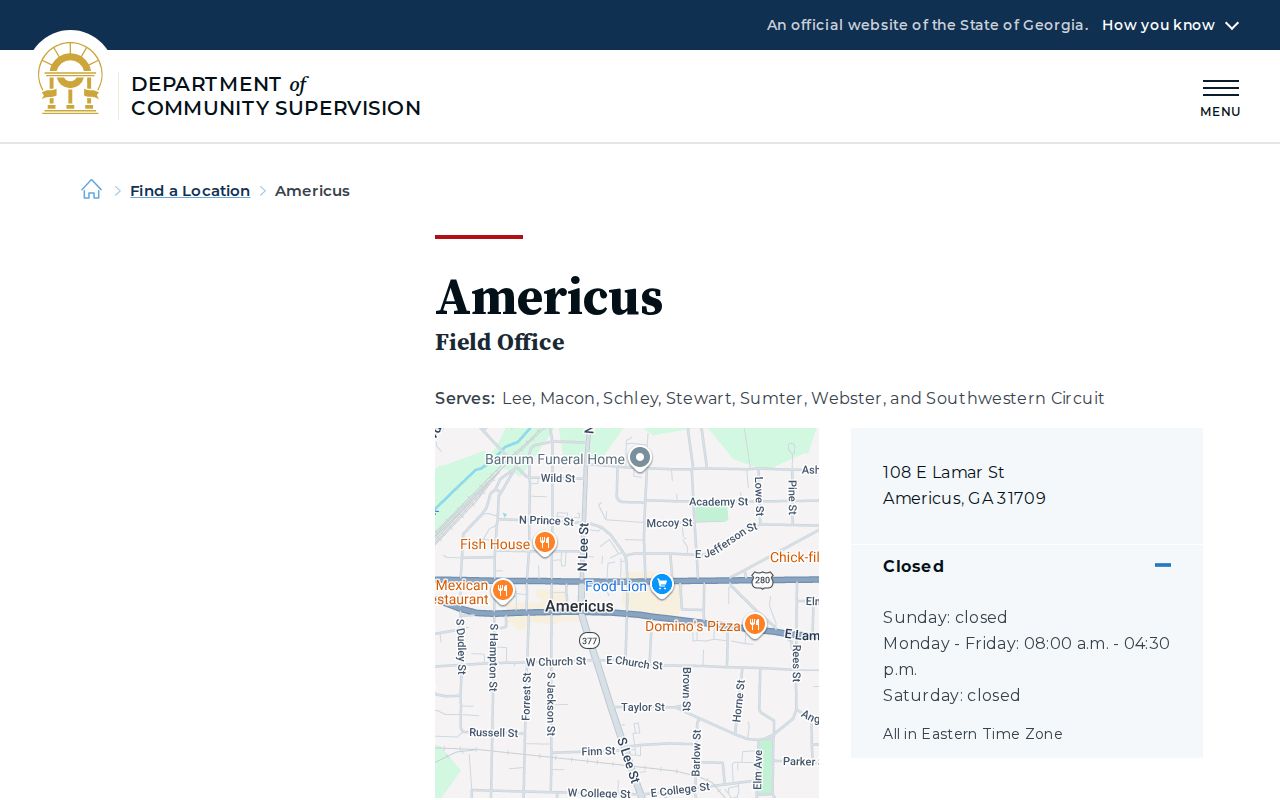
Use the office contact to confirm routing, not to infer an individual's status from geography alone.
Schley Supervision Violations and Warrants
No official Schley County absconder list was found in the reviewed county sources. State parole and DCS channels are therefore the better paths for a supervision status. The sheriff can address local warrant or hold questions. An absconder label means the person is alleged to have failed to report or comply and may face warrant action. It is not an invitation for a member of the public to approach or detain anyone.
Conditions vary with the court order, Board certificate, and supervision plan. They may concern reporting, approved residence, travel, treatment, payment, or conduct, but no single generic list proves what applies in one Schley case. A violation allegation can lead to an investigation, warrant, hearing process, changed terms, or return to custody. For an immediate safety concern, contact law enforcement. For the record of a state-supervision action, DCS maintains an open-records custodian, and requests may carry lawful charges under the Georgia Open Records Act.
Schley Supervision Record Sources
A complete Schley County supervision check may require more than one state or local record. The Parolee Database is the direct post-release source for a person on parole. Its search fields include first name, last name, race, case number, UPI number, and GDC ID. The Inmate TPM Lookup serves a different stage. It accepts a six-digit inmate number, GDC ID, or personal data and reports parole-consideration information when available. A TPM result concerns a person before a final parole release decision, while a parolee result concerns supervision after release.
Probation begins with the court record. Schley Superior Court and the clerk handle the felony criminal-record path at 47 Pecan Street in Ellaville. The sentencing order can show whether probation was imposed alone or after a custody term. DCS holds the field-supervision record for adult felony probation and parole. When a DCS record is needed, the agency's Open Records Custodian states that requests fall under the Georgia Open Records Act and may be billed. Describe the person, case, date range, and record sought with enough detail for staff to identify it.
Current custody sources answer another question. The Schley County Sheriff can confirm whether someone remains in the county jail or has a local warrant or hold. GDC Find an Offender can show state custody and release-related information for people in the Georgia prison system. Georgia VINE can provide custody-status alerts for participating records. None of those tools, by itself, proves the exact terms of a probation order or the full contents of a parole certificate.
| Schley question | Primary source | What it establishes |
|---|---|---|
| Is the person on parole? | Parolee Database and Board | State parole status |
| Was probation ordered? | Schley sentencing court | Sentence and probation term |
| Which office supervises? | DCS field-office routing | Office serving the approved residence |
| Has custody changed? | Sheriff, GDC, or Georgia VINE | Jail, prison, release, or transfer status |
Match the source to the question before drawing a conclusion. A Schley conviction does not prove that the Americus office currently supervises the person, because DCS routing follows the approved residence. Likewise, a person can finish jail custody without parole or probation. The official court, Board, and DCS records resolve those differences.
How Schley Supervision Ends
Supervision ends through an official act, not merely because a name stops appearing in a search. Parole may reach discharge under the Board's authority. Probation may end when the court-ordered term is completed or a court changes the sentence. A transfer between DCS offices changes who supervises the case but does not itself end the term. The clearest proof is the discharge record, court order, or official state status.
VINELink can send custody-change alerts, but it is not the official supervision file. A person may leave jail and begin probation, leave prison on parole, transfer to another authority, or complete custody with no community supervision. Those outcomes should not be collapsed into one word such as “released.”
Property After a Schley Release
Release property depends on which system held the person. GDC publishes a Georgia Release Card process for state-prison releases. Funds left on a released person's account move to that card. Activation uses the listed card service number, a four-digit PIN, and identity details from the card and released person. That process does not apply to an ordinary bond release from Schley County Jail.
For a local jail release, call the Schley County Sheriff at 229-937-2101 and ask how personal property is returned. For a GDC release card, consult the official Georgia Release Card instructions; the published activation line is 866-777-5729. Keeping these channels separate avoids sending a county jail property question to the state prison card vendor.
Schley Parole Meetings Explained
Georgia's monthly Parole Board meetings are not hearings on individual Schley cases. The Board publishes notices, agendas, and cancellations through its press-release page. An official meeting notice states that offender cases are not discussed or considered at those public monthly meetings. Individual parole decisions are file reviews carried out through the Board process.
The Board meeting notice archive is useful for public policy and agency business. It should not be read as a calendar showing when one person will be released. For an individual, the TPM lookup, Parolee Database, and GDC offender record are the relevant tools.
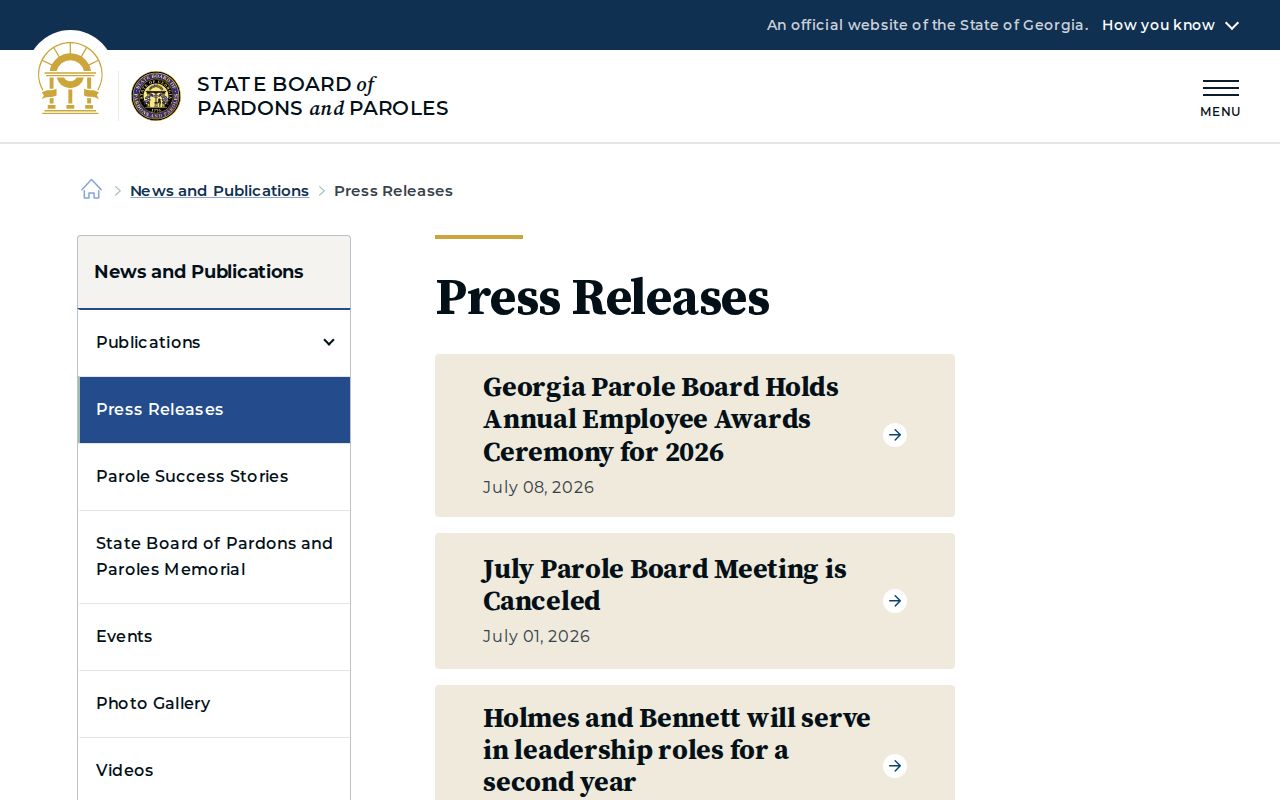
The archive confirms the Board's public schedule while keeping it distinct from individual case review.
Most parole-eligible Georgia inmates receive automatic consideration, so no personal application is needed. The general eligibility rule for many felony sentences is tied to one-third of the term, but eligibility does not equal release. Serious violent felony and recidivist rules may bar or alter parole eligibility. A Board result can deny parole, set or change a TPM, postpone action because conditions remain unmet, or authorize release to a detainer. Each outcome must be read with the GDC status and sentence record.