
Schley Projected and Actual Release
A projected date is a working calculation or decision point. An actual release date records what occurred. That difference is crucial in Schley County because the county jail, GDC, and Parole Board do not use one shared date field. A person awaiting trial at Schley County Jail often has no computed end date. Bond posting, a judge's order, time served, dismissal, a new hold, or transport paperwork can control the outcome.
A sentenced state prisoner may have a maximum or release-related date in the GDC detail record. A TPM is different. It marks the month when the Board expects to conduct final review and decide whether to set parole release. Neither field should be presented as a promise.
Find a Schley Projected Date
Choose the source by custody type. The GDC offender search covers people in Georgia state custody, not every person booked at Schley County Jail. Georgia.gov expressly directs county-jail questions to the county. The sheriff can confirm current local custody and the release record, while the sentencing court can confirm an order or sentence.
- Identify whether the person is in Schley County Jail, GDC custody, or another system.
- For the county jail, call the sheriff at 229-937-2101 and obtain the relevant court or release record.
- For state custody, open the GDC offender search and search by name, GDC ID, or case number.
- Match age, race, sex, conviction county, offense, and sentence before reading any date.
- Check status, facility, sentence, maximum release date, and other release fields shown.
- If parole eligible, check the Board's TPM tool, then verify unclear results with GDC or the Board.
The Schley County released-inmate lookup covers the broader records path after a date has passed. A person who is no longer on a live roster may require a release record or court disposition.
Georgia Sentence and Parole Timing
Georgia does not apply one simple “85 percent” rule to every state prisoner. For many parole-eligible felony sentences, the general eligibility point is after one-third of the prison term under O.C.G.A. § 42-9-45, subject to major exceptions. The Parole Board says eligibility is not a grant and few people are released at the first eligible point. Sentence computation remains a GDC function.
Credit for time already spent in custody is governed by O.C.G.A. § 17-10-11. Serious violent felony rules under O.C.G.A. § 17-10-6.1 can make a term-of-years sentence ineligible for parole, and recidivist rules can also alter eligibility. Offense date matters. Those legal distinctions are why a general arithmetic estimate cannot replace the official GDC computation and Board record.
For Schley County Jail, no official public good-time rule or projected-date calculator was found. A short local sentence may involve credit for prior jail days or time served, but the sheriff and court must confirm the actual record.
Why Schley Release Dates Change
A displayed date is only as stable as the sentence, conduct record, holds, and decision process behind it. Changes can move the expected date or change the destination without changing the date.
| Factor | Possible effect | Best confirmation |
|---|---|---|
| Board review | TPM may lead to a date, delay, or denial | Parole Board tools |
| Institutional conduct | Poor conduct may delay TPM or defeat release | Board and GDC record |
| Performance Incentive Credit | Eligible progress may advance TPM | Board decision record |
| Court order | Sentence or local jail date may change | Sentencing court |
| Detainer or hold | Release may become transfer to another authority | Holding agencies |
| Paperwork and transport | Actual local departure may differ from an estimate | Schley County Sheriff |
A detainer may come from a local, state, federal, or military authority. The Board can parole a person to that detainer. In that case, “release” means departure from one custody system and arrival in another, not return to the community.
Confirm a Schley Release Date
Use a second official channel before treating a date as final. For county custody, ask the sheriff whether the person remains held, was released, or was transferred. The court record can explain bond, sentence completion, or an order. For GDC custody, compare the offender detail with the Board record and request written verification from Inmate Records and Information when the status is unclear.
Georgia VINE can send a custody-change alert for a participating record. It is a notification system, not the formal release record. The Schley VINE inmate check explains how to register and what to do during a data outage. A missing result alone does not prove release.
Schley TPM Is Not Release
Georgia's Tentative Parole Month is a distinctive part of release-date research. The Board uses it as the time for final review. It may then set a release date if appropriate, but the TPM itself is not a final parole decision. The underlying sentence, offense eligibility, conduct, program progress, release plan, and detainers still matter.
The official TPM explanation states that distinction. Its captured page provides a visual check on the meaning of the field.
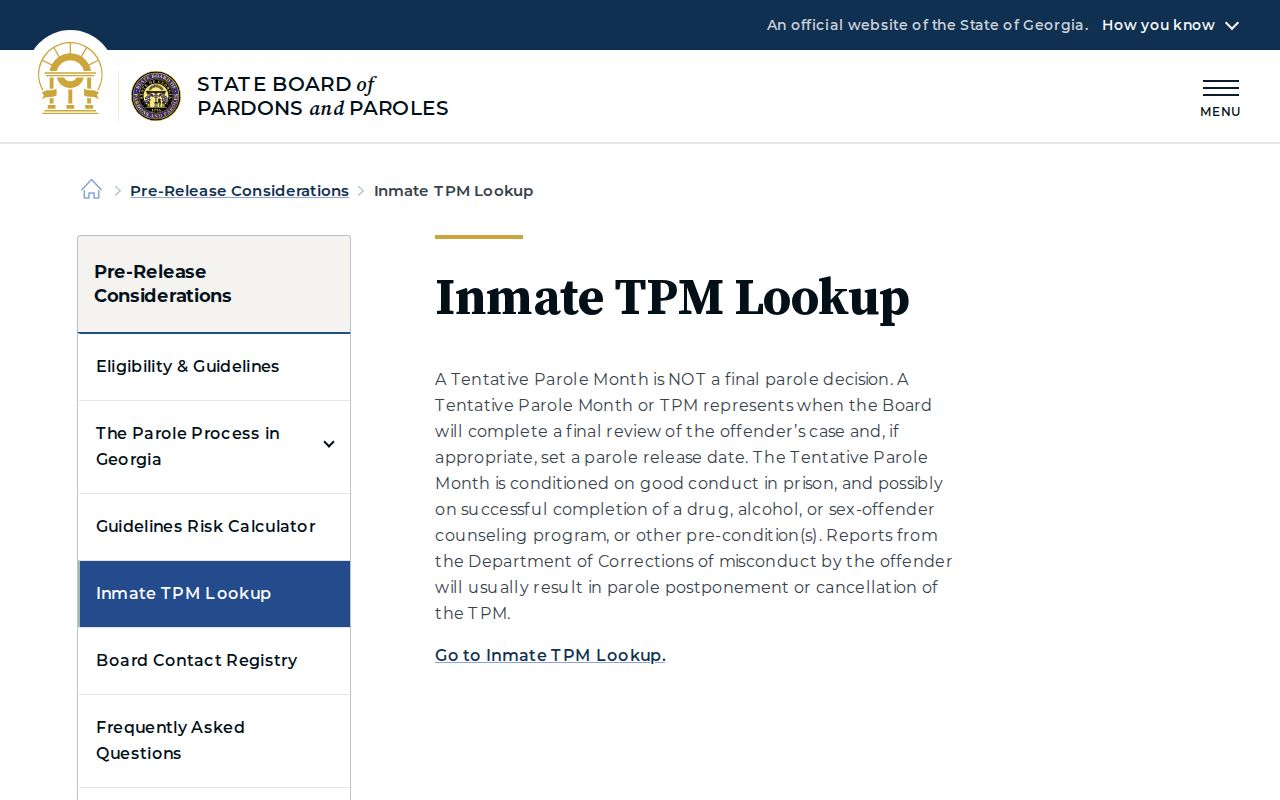
A TPM can be useful for timing expectations, but only a later final review can produce a parole release date.
Schley Release Dates and PIC
The Performance Incentive Credit program can change a TPM for eligible Georgia prisoners. The Board may advance it by a few months for satisfactory work, good behavior, and progress in education or treatment. Poor institutional conduct may delay the TPM or lead to denial, and the Board states there is no fixed cap on time added for poor performance.
The Parole Decision Guidelines describe PIC and detainers. The successful page capture below supports this Georgia-specific computation detail.
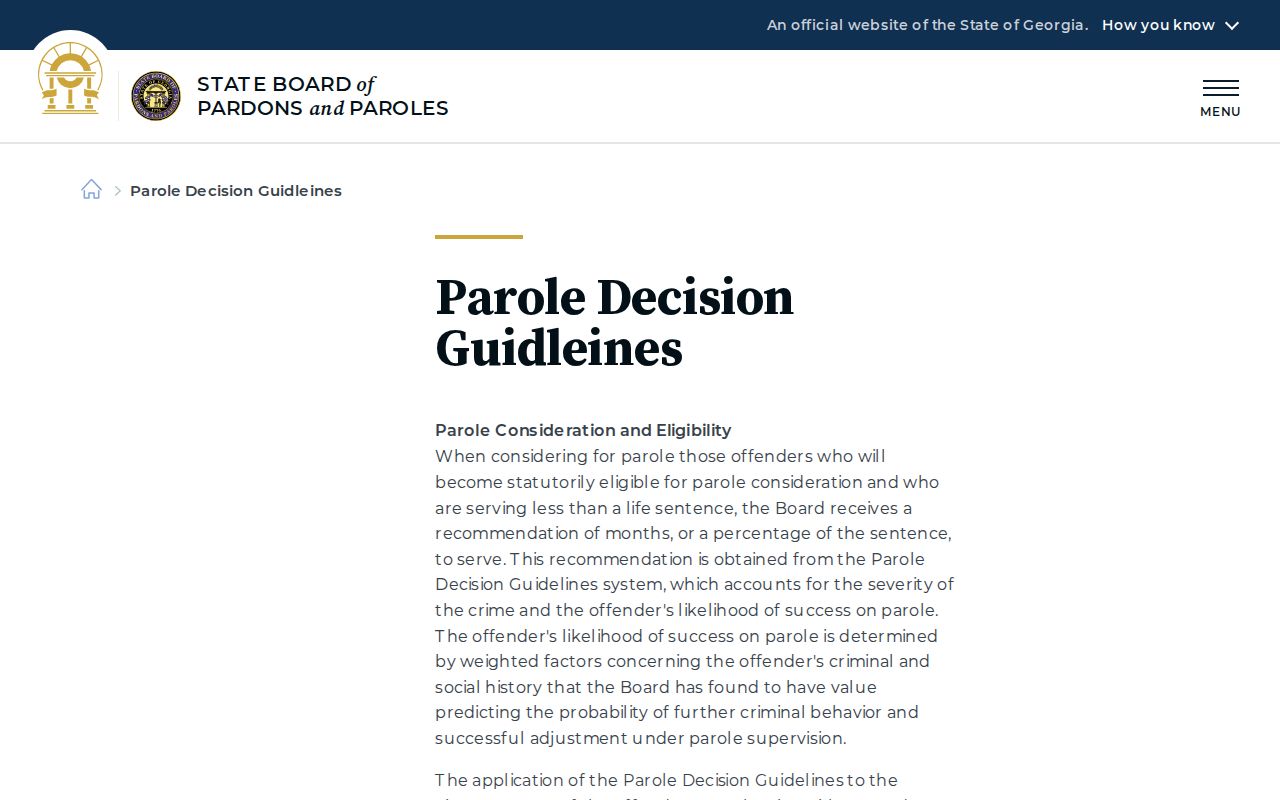
PIC affects a parole review month, not a county-jail bond release and not every GDC sentence.
Schley Parole Eligibility Limits
Parole eligibility is only one input in a Georgia projected release date. Under the general felony rule described by the Parole Board and O.C.G.A. § 42-9-45, many eligible prisoners may receive consideration after serving one-third of the sentence. A sentence of at least twenty-one years can carry a seven-year eligibility point under that general framework. These points open review; they do not create a right to leave custody on that day.
The offense and its date can replace that general rule. The Board identifies specified serious violent felony term-of-years sentences for offenses committed on or after January 1, 1995, as ineligible for parole. Its handbook explains that such a term may require every day of the sentence to be served. Recidivist provisions under O.C.G.A. § 17-10-7 can also bar or alter parole consideration. Life sentences use separate eligibility periods, including rules tied to whether the offense occurred before 1995, after 1995, or involved a serious violent felony committed on or after July 1, 2006.
A Schley court case therefore needs its exact sentence, offense category, and offense date before any parole estimate is meaningful. Credit for prior jail time is a separate GDC sentence-computation issue under O.C.G.A. § 17-10-11. Even when a person is eligible, the Board may deny parole, set a TPM, advance or delay that month, or require further review of conduct and the release plan.
Use the GDC detail record and TPM lookup together, but do not merge their fields. A maximum release date reflects sentence computation. A TPM marks a Board review point. A final parole release date follows Board action and may still be affected by a detainer. For a local Schley County Jail sentence, none of these state parole rules substitutes for the sheriff's release record and the sentencing court's order.
Schley Release Record Checks
A phone answer can settle whether someone remains in Schley County Jail, but a written record is stronger for a past event. Ask the sheriff for the booking and release record, including the release date and time, reason, bond, charge, court case number, and any hold or transfer notation that can lawfully be produced. The exact fields depend on the local system and permitted redactions.
For a sentence or order, use the correct court. Schley Superior Court and its clerk are the felony and criminal-record path. Magistrate Court may hold first-appearance, warrant, or bond context, while the county page identifies Probate Court with traffic matters. A court filing may explain why a person left custody even when no current jail entry remains.
Georgia open-government guidance provides a three-business-day response framework when responsive records are available. If records cannot be produced in that period, the agency should describe them and provide a timetable. Lawful search, retrieval, copying, or redaction costs may apply. That process confirms a past Schley release; it is different from predicting a future one.
Match Schley Release Date Records
Names alone can lead to the wrong state record. The GDC search permits name, ID or case number, age, and other identifying details. Compare every match with year of birth, race, sex, offense, county of conviction, sentence, and facility. A GDC ID or case number is usually stronger than spelling alone.
Read the status next. A release date may describe a GDC discharge, parole event, maximum sentence end, or another custody change. If the detail is unclear, GDC directs written verification to Inmate Records and Information at P.O. Box 1529, Forsyth, GA 31029. That safeguard matters when a Schley case has moved from county jail to state custody.
Schley Custody Changes the Date
A Schley County charge does not always mean the person stays in the county jail until the case ends. Local custody may hold a pretrial detainee, a person serving a short sentence, someone awaiting transfer, or someone held for another agency. Each path uses a different release clock. Bond can end local custody without ending the case. A sentence can establish an end point, while a warrant or detainer can block return to the community.
Transfer to GDC changes the source. Once a person enters state custody, GDC sentence computation and the offender detail become central. If parole is possible, the Board process adds eligibility, TPM, final review, and release-plan checks. A federal or immigration hold is separate again. The date someone leaves Schley County Jail may then be a transfer date, not a full discharge from all custody.
Ask a precise question when calling an office. “Is the person still held here?” addresses present custody. “What date and reason appear on the release record?” addresses a past local event. “Was the person released to the community or transferred?” tests the destination. “Which court order or state record controls the sentence?” points to the document behind the date. Clear terms reduce the risk of treating a booking release, state parole date, sentence maximum, and final discharge as the same event.